Griddle Pan vs. Frying Pan: Which One Should You Use for Vegetables?
A frying pan is the better all-purpose choice for most vegetables because its raised sides make stirring, tossing, and adding sauces easier. A griddle works better when broad vegetable slices need to cook in a single layer. If easy food release and moderate-temperature cooking matter, a ceramic frying pan is particularly useful for quick sautés and tender vegetables. The right tool ultimately depends on the vegetable’s shape, moisture content, and the surface finish you want.
How Griddles and Frying Pans Differ
Shape and Edge Design
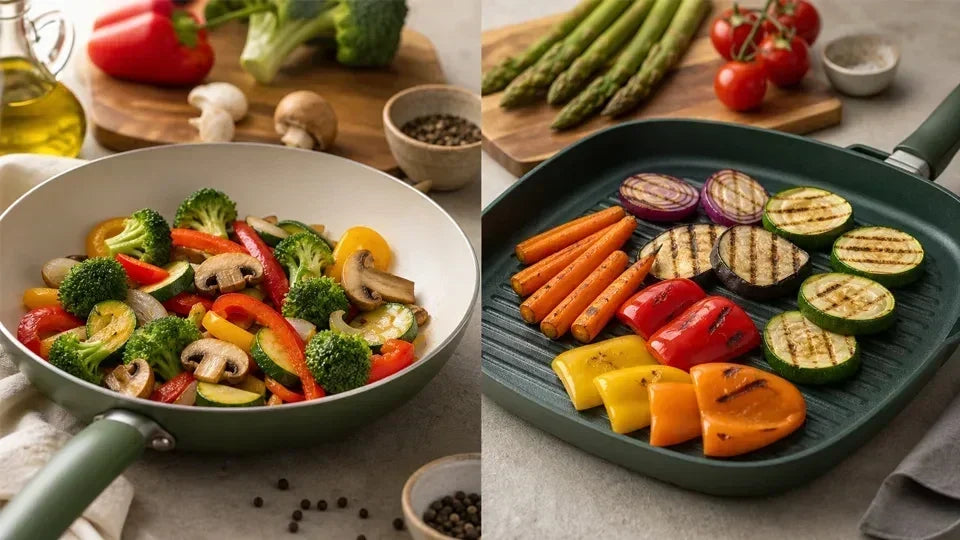
The main difference is shape. A griddle has a broad, flat cooking surface with very low edges, while a frying pan has higher sides that are usually curved or flared.
Low edges make it easy to slide a spatula beneath eggplant rounds, zucchini planks, onion slices, and portobello caps. They also allow moisture to escape freely. However, chopped vegetables can be difficult to stir without pushing pieces over the edge.
A frying pan contains food more effectively. Its sides provide room to stir mushrooms, toss green beans, or combine peppers and onions with seasonings. They can also hold small quantities of broth, sauce, or released vegetable juice.
Usable Cooking Surface
Surface area matters too. A spacious griddle can accommodate several large slices in one layer, provided the burner heats the base evenly. A frying pan of the same overall diameter offers less flat cooking space because the sides rise around the perimeter.
| Decision Factor | Flat Griddle | Frying Pan |
|---|---|---|
| Best vegetable cuts | Wide slices, halves, and rounds | Strips, florets, cubes, and mixed pieces |
| Stirring and tossing | Less convenient | Easier because the sides contain food |
| Single-layer cooking | Usually provides more open space | Depends on the flat base diameter |
| Cooking with liquid | Suitable only for very small amounts | Better for sauces, broth, and deglazing |
| Small vegetables | May roll over the edge | Easier to keep together |
| Mixed stir-fries | Less practical | Usually the better option |
In the griddle pan vs. frying pan for veggies comparison, neither tool wins every category. Choose a griddle for deliberate, single-layer cooking and a frying pan for movement, containment, and versatility.
Get a Good Sear With Ceramic Cookware
A ceramic frying pan can brown vegetables effectively at low to medium heat when the food is dry, the pan is gently preheated, and the pieces are not crowded. Excessive heat is unnecessary and may shorten the useful life of the ceramic nonstick surface.
Prepare Vegetables for Better Browning
Wash produce under running water, as recommended in the FDA’s produce safety guidance, and dry it thoroughly. Water on the surface turns to steam, which softens vegetables and delays browning.
Cut pieces to a consistent thickness so they cook at roughly the same rate. Preheat the pan gently, add a small amount of oil, and arrange the vegetables in one layer. Leave space between pieces so moisture can escape.
Do not stir immediately. Give the first side time to make uninterrupted contact with the pan, then turn the pieces after they develop color. If liquid begins collecting in the pan, reduce the batch size instead of increasing the burner setting.

Give Dense Vegetables a Head Start
Dense vegetables such as carrots, potatoes, and thick broccoli stems may remain firm inside by the time their surfaces brown. Briefly steaming, blanching, or microwaving them first can shorten their pan time. Softer vegetables such as mushrooms, zucchini, and bell peppers can usually go directly into the pan.
DELUXE’s proper use and care guide recommends low to medium heat, gentle preheating, and a small amount of oil for its hybrid ceramic cookware. It also warns that overheating can damage the nonstick surface.
Create Grill Marks on Indoor Vegetables
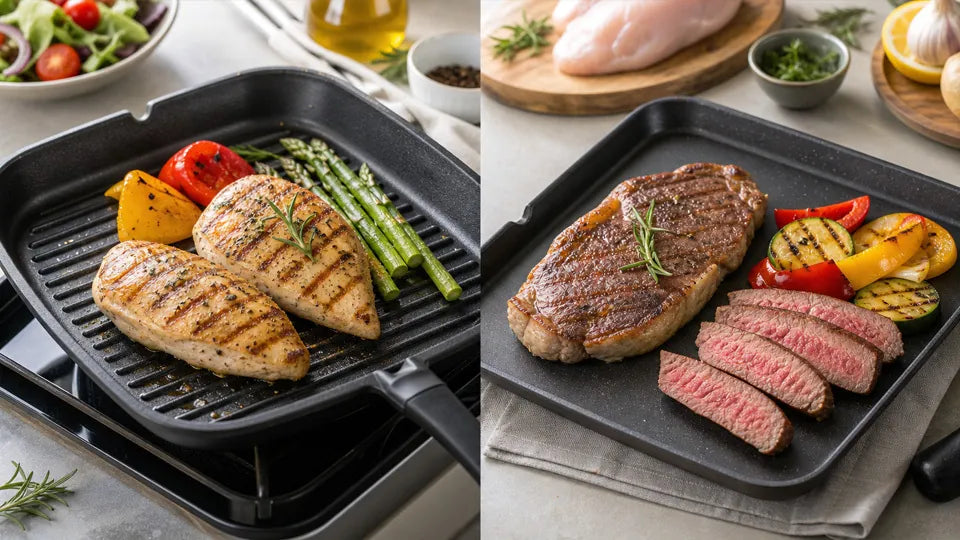
For distinct parallel grill marks, use a ridged grill pan rather than a flat griddle. A flat griddle can produce even browning, but it cannot create the line pattern associated with grill grates.
Check the Cooking Surface
This distinction matters because “griddle pan” can describe different cookware in different markets. In the United States, a griddle normally has a flat surface, while a grill pan has raised ridges. Check the cooking surface rather than relying on the product name alone.

Choose Cuts That Hold Grill Marks
For the best way to grill vegetables indoors, select broad pieces that can rest across several ridges. Zucchini planks, eggplant rounds, halved peppers, onion slices, asparagus, and portobello caps work better than loose peas or tiny florets.
Cut pieces evenly and dry them well. Cornell Cooperative Extension recommends similarly sized vegetable pieces for more even cooking. Brush a light coating of oil onto the vegetables instead of pouring a pool into the pan.
Build Clear Lines Without Overcooking
Place each piece across the ridges and leave it undisturbed while the first lines form. Rotate it about 90 degrees for a crosshatched pattern, then turn it over to finish the other side. Judge doneness by tenderness as well as color because cooking times vary by vegetable and thickness.
A flat griddle remains useful when decorative lines are not essential. Its uninterrupted surface gives food more contact with the pan, creating a wider browned area. It also supports small or irregular pieces that would sit unevenly on ridges.
Compare Oil Use Across Pan Types
Oil use depends more on the cooking surface and technique than on the pan’s name. A ceramic pan may need only a thin film for many vegetables, while bare stainless steel usually requires more careful preheating, oil coverage, and temperature control to limit sticking.
Apply Oil According to the Cooking Surface
A griddle’s broad surface may require more total oil to coat fully. Applying the oil directly to vegetables with a brush or tossing them in a bowl can provide consistent coverage without leaving excess oil on the cooking surface.
A frying pan concentrates oil within its smaller flat base. Its raised sides also contain oil and vegetable juices during stirring. For a quick sauté, add enough oil to lightly coat the active cooking area rather than measuring according to the diameter at the rim.

Avoid Smoking Oil and Excess Residue
The American Heart Association notes that cooking oils can be used to coat pans and cook vegetables. It also advises against using oil after it begins to smoke because the oil starts to degrade at its smoke point. If smoking occurs, remove the pan from the burner and reduce the setting.
More oil does not automatically produce better browning. Excess oil may make thin vegetables greasy, while too little can leave seasonings dry and food stuck to exposed metal. Start with a light coating and add more only if the surface appears dry.
Some ceramic cookware instructions discourage aerosol cooking sprays because repeated heating can leave residue on the surface. Care requirements vary, so follow the directions supplied with the exact pan.
Match Each Vegetable to the Right Tool
Choose the pan according to the vegetable’s size, density, and moisture content. Large, sturdy pieces suit a griddle, while small, wet, or frequently stirred vegetables are easier to manage in a frying pan.
- Zucchini and summer squash: Use a griddle for long planks or thick rounds that need broad browning. Choose a frying pan for half-moons mixed with garlic, herbs, or other vegetables.
- Eggplant: Thick rounds and lengthwise slices fit well on a griddle because they can remain flat. Cubed eggplant is easier to turn and contain in a frying pan. Apply oil evenly because eggplant can absorb it quickly.
- Bell peppers and onions: A frying pan is the practical choice for strips intended for fajitas, grain bowls, or mixed sautés. Halved peppers and sturdy onion rounds can go on a griddle when large browned surfaces matter more than frequent tossing.
- Mushrooms: Sliced mushrooms benefit from a roomy frying pan. They release water as they cook, so crowding can make them simmer in their own liquid. Whole portobello caps can sit flat on a griddle or ridged grill pan.
- Asparagus and green beans: Both work well in a frying pan, where the sides keep slender pieces from escaping. A broad griddle can handle asparagus spears if they are arranged carefully and turned with tongs.
- Broccoli, cauliflower, and Brussels sprouts: A frying pan is easier for florets and halved sprouts because their shapes are irregular. Add a small splash of water and cover briefly if the centers need more cooking, then uncover and let the moisture evaporate before browning.
- Potatoes and carrots: These dense vegetables often need a head start. Parboil or steam them until partly tender, dry the surfaces, and finish them on a griddle or in a frying pan.
- Leafy greens: Choose a frying pan with enough capacity. Spinach, kale, and chard begin bulky and collapse as they cook, making raised sides far more useful than a griddle’s open surface.
Choose a Frying Pan for Quick Stir-Fries
The best frying pans for quick stir-fry sessions have sufficient flat space to prevent crowding, sides that contain food during stirring, and a responsive base that performs well at moderate settings. A skillet-style pan works well for moderate portions, although a wok may be more practical for larger batches and vigorous tossing.
Add Vegetables in the Right Order
Prepare every ingredient before heating the pan. Begin with dense vegetables such as carrots, broccoli stems, or green beans. Add peppers, mushrooms, zucchini, and leafy greens later so the softer ingredients do not overcook.
Aromatics can burn when left against the pan for too long. Move garlic or ginger through the vegetables instead of leaving it in an empty section of the cooking surface.

Focus on the Usable Flat Base
The diameter at the rim does not reveal how much food a pan can brown at once. Check the width of the flat base, which is the area that receives direct heat and supports the vegetables. For a generous serving, cook in batches and combine everything at the end. This preserves texture and reduces the liquid that often accumulates in an overcrowded pan.
Use Ceramic Cookware at Moderate Heat
A ceramic pan is useful for moderate-temperature stir-frying, particularly with vegetables that tend to stick or sauces containing a little sugar. It should not be treated as interchangeable with bare stainless steel or a traditional wok. Each material and shape requires a different cooking approach.
The DELUXE frying pan collection includes hybrid cookware made with stainless steel and ceramic nonstick materials. When comparing options, focus on the usable base, your normal portion size, and the exact care guidance rather than assuming every pan serves the same purpose.
Pick the Pan That Fits the Cut
A frying pan is the most flexible option for everyday vegetables, especially when ingredients need frequent stirring, a little liquid, or room for sauce. Choose a flat griddle for broad slices cooked in one layer and a ridged grill pan when visible grill lines are the goal.
Use a ceramic frying pan at low to medium heat with dry vegetables, light oil, and enough room for steam to escape. If open-surface cooking better fits your menu, consider the DELUXE 13-inch hybrid ceramic griddle pan, which has a flat hybrid ceramic-and-stainless-steel surface, an aluminum core, and compatibility with gas, electric, induction, and ceramic cooktops.
Common Questions About Cooking With and Caring for Ceramic Pans
Q1. Can Frozen Vegetables Go Straight Into a Ceramic Pan?
Sometimes, depending on the vegetable and desired texture. Frozen vegetables release considerable water, so thawing and drying them first usually supports better browning.
Q2. Should Vegetables Be Salted Before Pan Cooking?
It depends on the vegetable. Salt can draw moisture from zucchini, eggplant, and mushrooms, so adding it later may help when surface browning is the priority.
Q3. Can You Use Metal Tongs on a Ceramic Pan?
Only if the exact product instructions permit them, and even then they should be used gently. Wood, silicone, or nylon tools are the more cautious choice for limiting wear.
Q4. Does a Griddle Pan Need a Lid?
Usually not for browning thin vegetable slices. A lid can help dense vegetables cook through, but trapped steam softens the surface, so uncover the pan before the final browning stage.
Q5. How Should a Ceramic Pan Be Cleaned After Vegetables?
Usually, allow it to cool and wash it with warm, soapy water and a soft sponge. Avoid sudden temperature changes and abrasive cleaning unless the product instructions specifically allow another method.