What Is a Wok and Why Is It Different From a Frying Pan?
A wok is a deep, bowl-shaped vessel with high, sloping walls designed for high-heat tossing and rapid evaporation, whereas a frying pan is a shallow tool with a flat bottom optimized for even searing and surface contact. The primary difference lies in their thermal dynamics: woks concentrate heat at a central "hot spot" for stir-frying, while frying pans distribute heat across a wide base for browning proteins. Choosing between a wok and a pan depends on whether you are preparing small, fast-moving ingredients like stir-fries or larger, static items like steaks and pancakes.
What Is a Wok?
A wok is a versatile Asian-origin cooking vessel characterized by its high, slanting sides and traditionally rounded bottom. For most of us in the States, it has become a kitchen staple for replicating professional-grade stir-fry results or serving as a multi-functional pan that can handle everything from deep-frying to steaming.
Understand the Traditional Carbon Steel Design
The vast majority of professional woks are made from carbon steel. This material is a game-changer because it is lightweight enough to toss with one hand and responds almost instantly to changes in your stove's heat. Like a good cast iron skillet, a carbon steel wok requires "seasoning"—a process of baking oil into the metal to create a natural, nonstick patina that improves the more you use it.
Explore the Versatility of the Wok Shape
Do not let the name fool you; a wok is much more than just a stir-fry tool. Because of its significant depth and volume, it acts as a perfect cooking pot for deep-frying chicken wings or tempura. The flared sides act as a built-in splash guard and require much less oil than a wide Dutch oven to submerge your food. It also doubles as a steamer when you drop in a bamboo basket or a boiling pot for quick ramen sessions.
Identify Common Handle Styles
In American stores, you will usually see two types of handles. "Northern-style" woks feature one long wooden handle, making them easy to maneuver and toss like a standard skillet. "Cantonese-style" woks have two small metal loop handles, which are great for stability when carrying a heavy load but much harder to use if you want to master that professional tossing motion.

How Is a Wok Different From a Frying Pan?
The fundamental difference in the wok vs. frying pan debate comes down to how each vessel manages heat, moisture, and movement. Frying pans are built for stability and conduction, while woks are built for agitation and convection.
Compare Surface Area and Contact
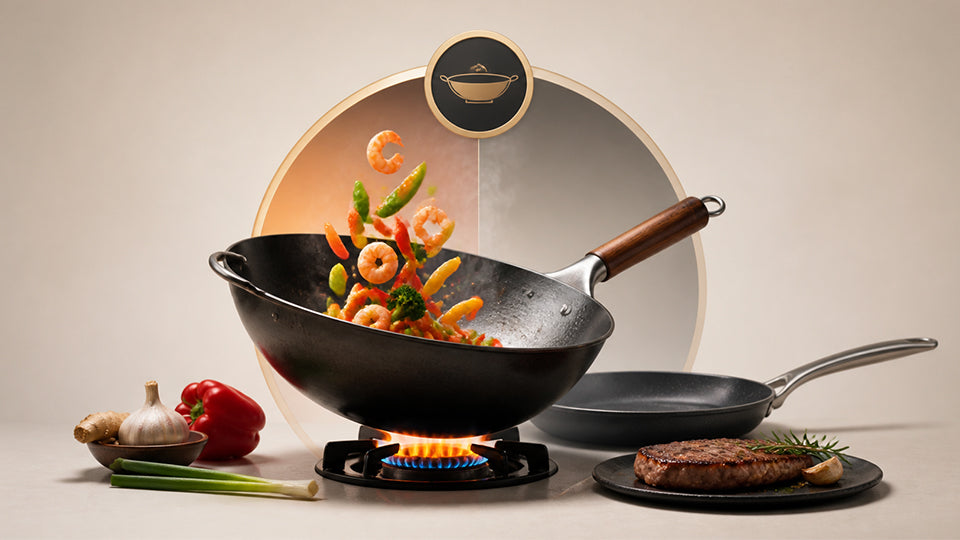
Frying pans prioritize a wide, flat base to maximize contact between the heat and your food. This is the "must-have" feature for building a perfect crust on a burger or a grilled cheese. A wok, however, has a tiny contact point at the base. It encourages "constant motion" cooking where food is tossed through a pocket of superheated air, ensuring your vegetables stay crisp and seared rather than soggy.
Analyze Heat Distribution and Wok Hei
"Wok Hei," or the "breath of the wok," is that smoky, charred flavor you get from high-end takeout. Because a wok is deep, it creates a concentrated heat pocket. When you toss ingredients, moisture vaporizes instantly, and fats undergo a brief combustion. This signature flavor is impossible to replicate in shallow frying pans because the steam escapes too quickly, preventing the concentrated heat needed for that smoky finish.
Evaluate Capacity and Splashing
The high walls of a wok allow you to cook a massive volume of food—like a giant batch of fried rice or a whole bag of spinach—without making a mess on your counter. In a standard skillet, the low sides limit your ability to toss food vigorously. You are often forced to use a spatula to carefully turn food over, which frequently leads to "crowding the pan" where food steams in its own juices rather than searing.

What Foods Are Best Cooked in a Wok?
The best wok to buy is one that helps you master ingredients that are small, uniform, and require rapid cooking. It is the ultimate tool for recreating American-Chinese takeout classics and experimenting with high-heat vegetable dishes.
Recreate American-Chinese Takeout Favorites
Classic dishes like General Tso’s Chicken, Beef with Broccoli, and Orange Chicken are made for the wok. The high walls allow the sauce to thicken into a glossy coating while the protein stays crispy. Because the heat is so concentrated, you can flash-cook the broccoli so it stays bright green and "snappy" rather than turning into a mushy side dish.
Use the Wok for Safer Deep-Frying
Many home cooks find the wok to be their favorite tool for frying up Sunday appetizers like mozzarella sticks or egg rolls. Its bowl shape means you can submerge food in less oil compared to a flat-bottomed pot. Plus, the wide, flared top catches most of the oil splatter, which keeps your stovetop cleaner and significantly reduces the risk of grease fires.
Experiment With Western Applications
The wok is surprisingly versatile for non-Asian meals. It is the perfect tool for making fajitas, as the high heat mimics a commercial griddle for that perfect char on peppers and onions. It is also arguably the best popcorn maker in the world; the sloped sides allow unpopped kernels to fall back into the hot oil at the center while the popped corn stays on the cooler sides, preventing any burnt pieces.

What Foods Are Better in a Frying Pan?
Frying pans are the clear winners for "static" cooking where you need even, prolonged contact with the surface. For the classic American breakfast and "meat and potatoes" dinner, a flat-bottomed pan is irreplaceable.
Master Breakfast Staples: Eggs and Pancakes
Anything that starts as a liquid, like scrambled eggs, omelets, or pancake batter, needs a flat surface to set correctly. If you pour pancake batter into a wok, it is simply going to slide to the center and form a thick, uneven clump. A frying pan provides the uniform surface you need to flip pancakes easily and ensure your omelets are thin and cooked through.
Sear Steaks and Burgers
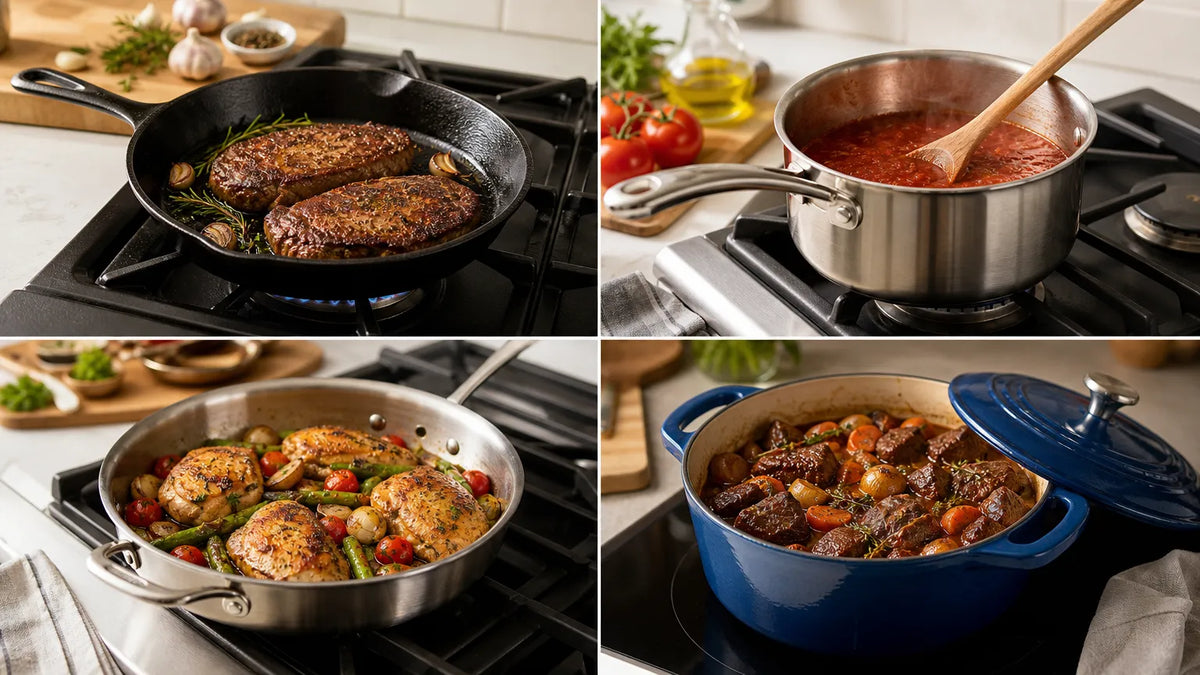
To get a restaurant-quality crust on a New York strip or a smash burger, you need the entire surface of the meat pressing firmly against a flat, hot base. Since a steak is flat, it cannot make full contact with the curved bottom of a wok. Frying pans provide the surface area required for the Maillard reaction (browning) to happen across the entire piece of meat at once.
Reduce Pan Sauces and Deglaze
If you are making a gravy or a reduction sauce after searing meat, reach for the skillet. The wide base allows moisture to evaporate quickly and evenly. Furthermore, the flat bottom makes it much easier to use a whisk or spatula to scrape up the "fond" (those flavorful browned bits), which is the secret to a professional-tasting sauce.

Is a Stir-Fry Pan the Same as a Wok?
When you are browsing the aisles at Target or looking on Amazon, you will see a stir-fry pan marketed as a "flat-bottomed wok." While they look similar, there are a few structural differences that affect how they perform on your stove.
Traditional woks have round bottoms, but since most American homes have electric or glass-top stoves, the stir-fry pan was born. It features a wide, flat base to sit securely on these surfaces. While it gives you the high walls of a wok, the transition between the base and the walls is usually more angular, which can slightly hinder that smooth, circular tossing motion.
Many "stir-fry pans" in big-box stores are made from thin aluminum or stainless steel, but if you are serious about your cooking, it is recommended to look for a composite stir-fry pan with a ceramic coating. Standard nonstick coatings (PTFE) are known for releasing fumes if you heat them to the "smoking point" needed for a real stir-fry. However, a high-quality ceramic-coated piece is heat-stable and non-toxic. When this is paired with a composite material base, you get the best of both worlds: the high-heat performance and even temperature of a professional wok, combined with the effortless, "wipe-away" cleanup of a modern pan.
Choose Between a Wok and a Pan Based on Your Stove
Your stove type is the ultimate deciding factor in the wok vs. pan choice. US kitchens vary from high-end gas ranges to modern induction tops, and each requires a specific type of cookware to get the best results.
Gas Stoves: The Natural Home for Woks
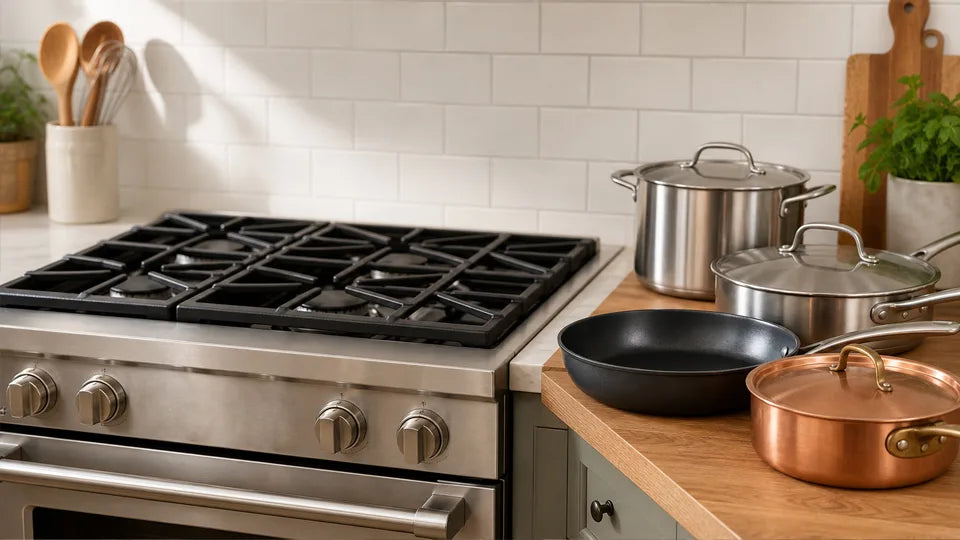
If you are lucky enough to have a gas range, you can use any wok you want. Round-bottom woks can be stabilized with a simple "wok ring." Gas is the gold standard because the flames wrap around the sides of the pan, heating the walls as well as the base. This gives you those varied temperature zones that make wok cooking so unique.
Electric and Induction: The Flat-Bottom Rule
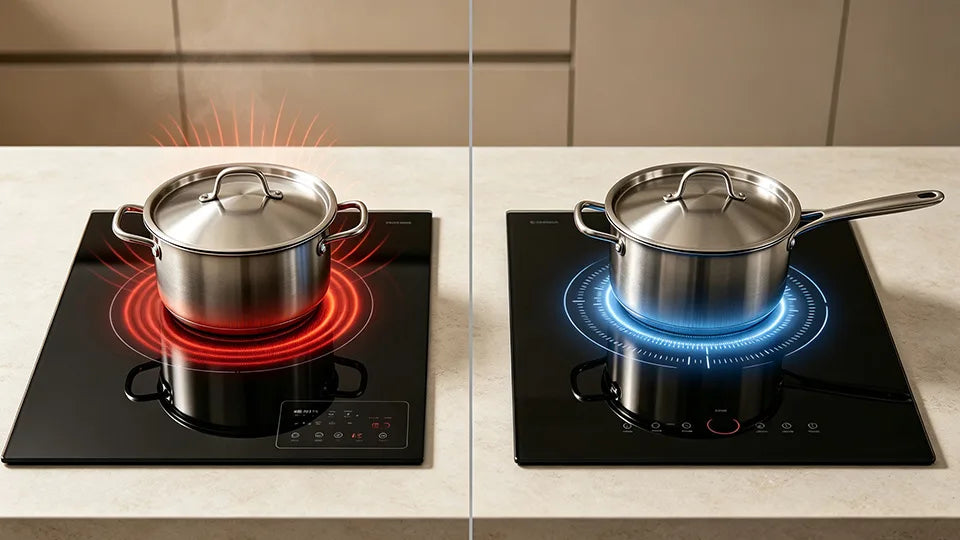
Electric coil and glass-top induction stoves need direct, flat contact to transfer heat. A round-bottom wok is a no-go here because it only touches the burner at a tiny point, leading to terrible efficiency and potentially scratching your glass top. For these kitchens, you have to use a flat-bottomed stir-fry pan or a standard skillet. If you are using induction, carbon steel woks with flat bottoms work like a charm.
Managing Thermal Recovery
Many residential electric stoves in the US take a minute to "recover" their heat once you drop in cold ingredients. A heavy cast iron skillet stores more thermal energy than a thin wok, which helps keep the temperature steady. If you are stir-frying on an electric stove, the pro tip is to cook in small batches to make sure the pan stays hot enough to sear rather than steam your food.

Find the Best Wok to Buy for Your Cooking Style
Picking the best wok to buy is all about finding the right balance between size and material. For most American homes, a 14-inch carbon steel wok with a flat bottom is the most versatile and durable choice you can make.
Why Carbon Steel Is the Winner
Professionals and hobbyists almost always go for carbon steel. It is responsive, tough as nails, and develops its own nonstick surface over time. Unlike stainless steel, which can be a nightmare for sticking at high temperatures, a seasoned carbon steel wok provides a smooth ride that only gets better with age. It is also much lighter and easier to toss than a cast iron version.
Sizing for the American Family
A 14-inch model is generally the best wok to buy for a family of four. It gives you enough room to toss food without overcrowding, which is the key to preventing sogginess. If you are in a small apartment or cooking for one, a 12-inch wok is a solid alternative, but keep in mind it can be a bit tight for large, leafy greens like bok choy or kale.
Look for Comfortable Handles
Try to find a wok with a securely riveted long wooden handle. Wood stays cool to the touch even when the metal is screaming hot. Many 14-inch woks also come with a small "helper handle" on the opposite side. This is a lifesaver when you are trying to carry a full wok of hot soup or oil across the kitchen safely.
Choose Wok or Frying Pan
A wok is a high-performance tool built for rapid motion and multi-functional cooking, while a frying pan is your reliable "daily driver" for even searing and delicate breakfast items. Understanding the difference between a wok and a pan helps you choose the right tool for the job, whether you are flash-cooking General Tso’s or browning a ribeye. By matching your cookware to your stove and your favorite recipes, you will expand your skills and get professional results right in your own kitchen.
FAQs About Woks and Frying Pans
Can a wok replace a frying pan in a small apartment?
Not completely. While a wok is incredibly versatile, you will really struggle to make things like pancakes, grilled cheese, or over-easy eggs. A wok’s curved base is specialized for movement, whereas a frying pan is essential for anything that needs to lay flat and still to cook properly.
Is a carbon steel wok better than a stainless steel one?
For stir-frying, absolutely. Carbon steel develops a "seasoning" that makes it naturally nonstick over time. Stainless steel is beautiful and great for acidic sauces, but it lacks that nonstick patina and can be a huge pain to clean if food burns onto the surface at the high temperatures used for stir-frying.
Do I need a wok ring for my gas stove?
You only need a wok ring if you are using a traditional round-bottomed wok. The ring stabilizes the bowl so it doesn’t tip over while you are cooking. If you have a flat-bottomed wok or stir-fry pan, it will sit directly on your stove grates just like any other pan in your cabinet.
Why is my food sticking to my new carbon steel wok?
New woks must be "seasoned" before their first use. If food is sticking, you probably need to build up more layers of oil seasoning or ensure the pan is "smoking hot" before you add your oil and ingredients. A hot pan combined with cold oil is the secret to a nonstick experience.
Can I sear a steak in a wok?
You can technically do it, but it is not the best tool for the job. Because the bottom is curved, only a small portion of the steak will touch the hottest part of the pan. For a consistent, edge-to-edge crust on a steak or burger, frying pans are much more effective because the entire surface makes contact.