How Does a Nonstick Pan Work? The Science of Cooking Without the Stick
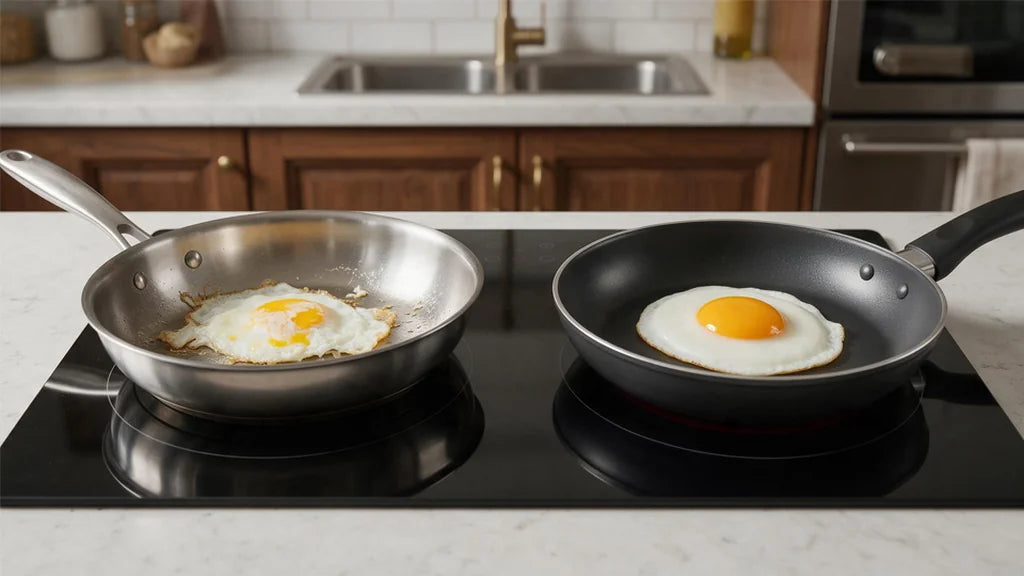
Have you ever cracked a fresh egg into a skillet, only to watch it tear apart and cement itself to the bottom? Cleaning burnt food residue off a pan is one of the most frustrating daily kitchen headaches.
If you’ve ever wondered why an egg glides effortlessly across a nonstick pan while sticking stubbornly to plain stainless steel, the answer isn't magic—it's a blend of surface physics and molecular chemistry.
In this guide, we’ll break down the science behind how nonstick coatings work, explore the evolution from traditional Teflon to modern ceramic cookware, and look at how 5-ply hybrid technology solves the classic dilemma between slickness and durability.
Why Does Food Stick to Regular Pans?
To understand how a nonstick coating works, we first need to zoom in on what happens when you cook on standard stainless steel or cast iron.

The Microscopic Roughness Problem
To the naked eye, a polished steel skillet looks completely smooth. But under a powerful microscope, metal surfaces look like jagged landscapes filled with tiny peaks, valleys, and pores.
When you heat a pan and drop in protein-rich foods like eggs, meat, or fish:
- Food proteins sink into these microscopic metal cracks.
- Heat causes the proteins to expand and cook inside the tiny pores.
- The food forms temporary chemical bonds with the metal atoms, effectively "locking" itself onto the pan.
- Regular Metal Pan (Microscopic View): Food Proteins --> [ v v v v v ] <-- Metal Cracks & Pores (Food gets trapped)
- Nonstick Coated Pan (Microscopic View): Food Proteins --> ------------ <-- Smooth Coating (Nothing to grab)
Without enough oil or appropriate temperature control, food is more likely to adhere to the metal surface.
How Does a Nonstick Pan Work? The Science Explained
Nonstick cookware solves the sticking problem through two main mechanisms: microscopic pore filling and low surface friction.

1. Filling the Microscopic Cracks
A nonstick coating acts like liquid filler on a rough wall. It covers irregularities in the base metal, creating a more uniform cooking surface with fewer exposed areas where food can adhere.
2. Extremely Low Surface Energy
Materials used in nonstick coatings possess exceptionally low surface energy. This means their atoms are already stably bound to each other and have no interest in interacting with outside molecules. Water, oil, and food proteins tend to adhere less strongly to the coating, which can make food easier to release when the pan is used correctly.
The Evolution of Nonstick Coatings: Teflon vs. Modern Ceramic
Over the decades, nonstick technology has evolved significantly due to health awareness and manufacturing innovations.
Traditional PTFE (Teflon): The Original Miracle
In 1938, scientists accidentally discovered polytetrafluoroethylene (PTFE), commercially known as Teflon.
PTFE is a chain of carbon and fluorine atoms. The bond between carbon and fluorine is one of the strongest in chemistry. Because all its chemical bonds are happily paired up inside the molecule, it refuses to bond with anything else—making it one of the slipperiest solid materials known.
- The Manufacturing Challenge: Getting a material that refuses to stick to anything to actually stick to a metal pan is a tricky manufacturing process. Factory technicians must grit-blast the aluminum base, apply special primer layers, and bake it at temperatures over 800°F.
- The Health Shift: Older PTFE pans relied on a chemical called PFOA during manufacturing. Due to environmental concerns, major participating manufacturers phased out PFOA under the U.S. EPA’s stewardship program. Today's health-conscious cooks increasingly seek out PFOA-free, PFAS-free, or ceramic-based alternatives.
Ceramic Coated Pans: A PFAS-Free Alternative
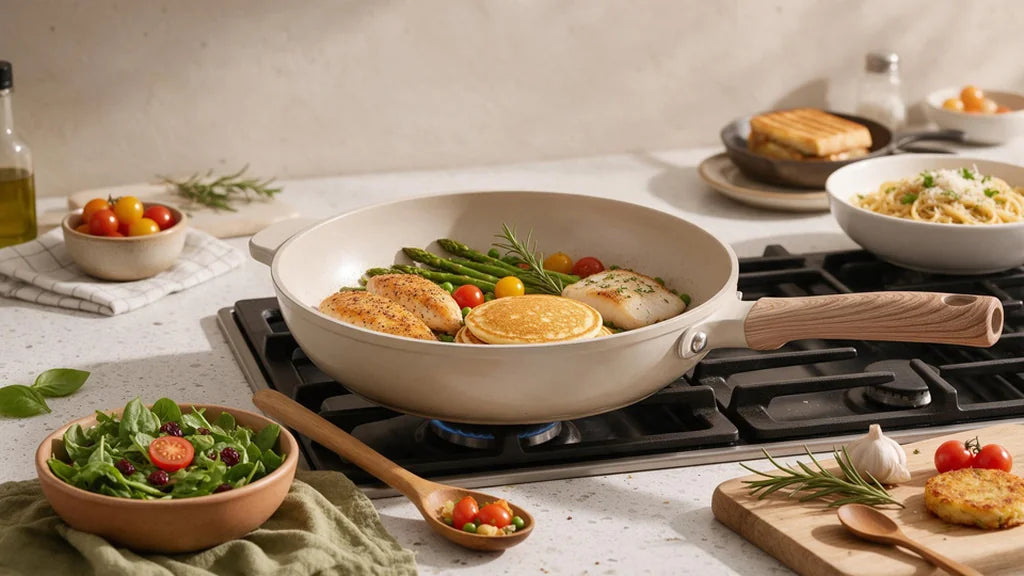
As demand grew for healthier kitchenware, ceramic-coated cookware surged in popularity.
Unlike PTFE, ceramic coatings are derived from natural silica (sand) using a process called Sol-Gel:
- A liquid silica solution is sprayed onto the pan and cured in a high-heat oven.
- It hardens into a slick, glass-like mineral surface.
- Depending on the formulation, a ceramic coating may be made without PTFE or PFAS. These claims should be verified for the specific product.
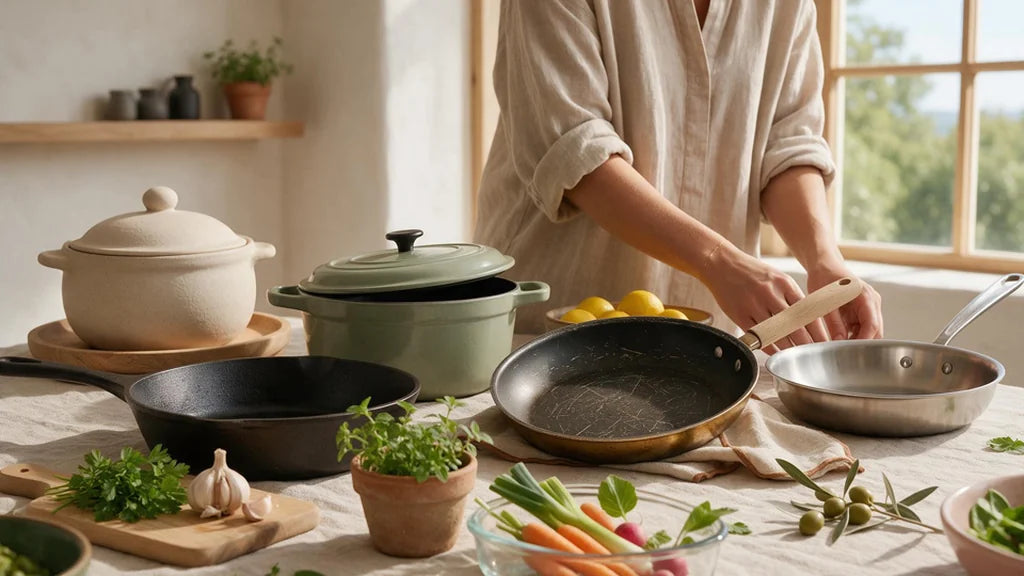
While ceramic pans offer peace of mind for daily cooking, traditional ceramic coatings have one weakness: the glass-like layer is somewhat brittle and can lose its nonstick release properties over time if exposed to high heat or metal utensils.

The Next Generation: 5-Ply Laser-Hybrid Cookware
If ceramic wears down easily and stainless steel sticks without technique, is there a way to combine the best of both worlds?
This trade-off inspired modern manufacturers to develop hybrid cookware, which pairs the durability of stainless steel with the easy release of nonstick coatings.
- 304 Stainless Steel Laser Mesh (Protects nonstick layer)
- Ceramic Nonstick Layer (PFAS-Free food release)
- 304 Stainless Steel Inner Core (Food-grade foundation)
- Pure Aluminum Core (Fast & even heat distribution)
- 430 Stainless Steel Base (Induction stove compatible)
For example, Deluxe Hybrid Cookware uses a 5-layer clad construction to solve traditional nonstick durability issues:
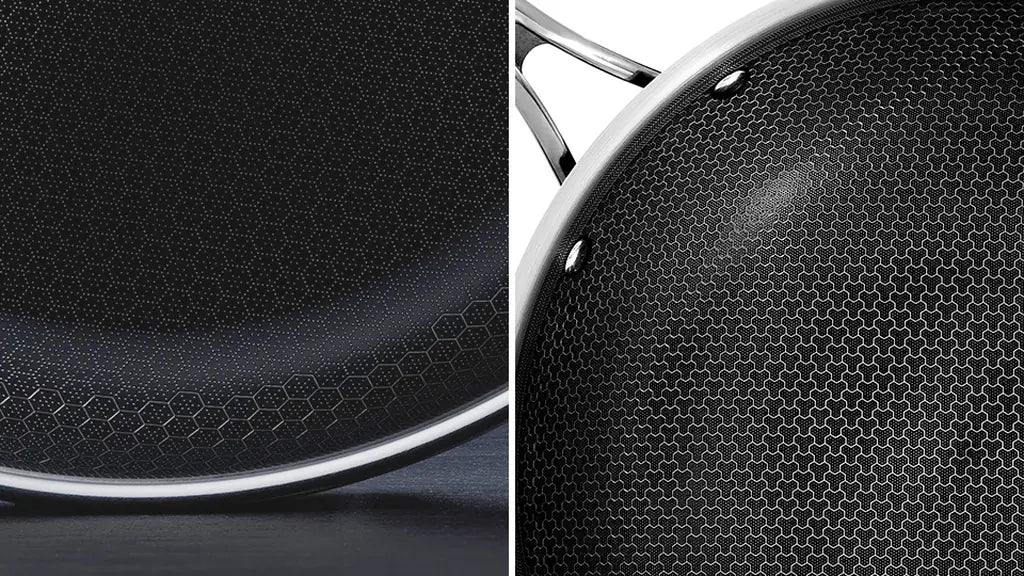
- Laser-Etched Stainless Steel Grid: Raised 304 stainless steel hexagonal peaks shield the sunken ceramic nonstick valleys from spatulas and physical wear.
- Non-Toxic Ceramic Base: Set safely below the steel grid, delivering easy food release without harmful chemicals.
- Encapsulated Aluminum Core: Sandwiched between steel layers to spread heat rapidly, preventing localized hot spots that burn food.
- Magnetic Exterior Base: Built with 430 stainless steel, making the cookware fully compatible with induction, gas, and electric cooktops.
This structure can support browning while making food release and cleanup easier when the pan is used over low to medium heat.

Quick Comparison: Which Material Suits Your Cooking Style?
| Cookware Type | Major Advantages | Key Considerations | Best Suited For |
|---|---|---|---|
| Traditional Ceramic | Non-toxic, eco-friendly, slick at low heat | Sensitive to thermal shock and high heat | Eggs, delicate fish, quick breakfasts |
| Stainless Steel | Extremely durable, oven-safe, great searing | Requires oil and proper preheating to avoid sticking | Searing steaks, pan sauces, deep frying |
| 5-Ply Laser Hybrid | Scratch-resistant, durable, induction-ready | Slightly heavier than single-layer aluminum | Everyday cooking, controlled browning, versatility |
Actionable Tips: How to Prevent Sticking and Extend Pan Life
Even high-quality cookware requires basic care to preserve its slick surface barrier:
- Keep Heat at Medium or Below: High heat breaks down nonstick coatings over time. Because heavy-gauge pans conduct heat efficiently, medium heat is usually plenty for most tasks.
- Preheat with a Small Drop of Fat: Adding a thin coating of butter or oil fills any lingering micro-gaps and improves heat transfer for even browning.
- Skip the Aerosol Cooking Sprays: Commercial aerosol sprays contain lecithin and propellants that carbonize when heated, leaving an invisible, sticky film that ruins nonstick surfaces. Use regular liquid oils instead.
- Avoid Thermal Shock: Plunging a scorching-hot pan straight into cold sink water causes the metal base to warp and degrades the coating. Always let the pan cool down before washing with a soft sponge.
Conclusion
Understanding the science behind nonstick cookware shows that cooking doesn't have to be a battle against sticky surfaces. By choosing well-engineered, non-toxic cookware and managing your heat properly, you can enjoy crisp searing, easy food release, and stress-free cleanup for years to come.
Frequently Asked Questions
Why does food start sticking to a nonstick pan after a few months?
Food usually starts sticking due to microscopic oil carbonization. Over time, tiny layers of burnt oil build up inside the surface pores, filling in the slick coating and creating a microscopic rough patch.
Is ceramic cookware safer than traditional PTFE pans?
That depends on how you cook. At normal cooking temperatures, both are considered stable; the difference matters mainly if pans are overheated or if you want to avoid fluoropolymers entirely. Ceramic coatings are formulated without fluoropolymers, so overheating does not produce the fluorocarbon decomposition products associated with PTFE. That said, high heat still degrades ceramic release performance over time, so medium heat remains the better habit regardless of coating type. Read more about our PFAS-free material standards.
Can I use metal utensils on a hybrid nonstick pan?
Yes, but use them carefully. DELUXE states that metal utensils may be used on its current hybrid cookware, although sharp edges or forceful scraping can still damage the coating or leave marks over time.
How do I know if my pan works on an induction stove?
For a pan to work on an induction cooktop, its bottom layer must contain magnetic metal (like 430 grade stainless steel). You can test your pan at home by placing a magnet on the bottom—if it sticks firmly, it is induction compatible.