What Does PFAS-Free Mean in Cookware?
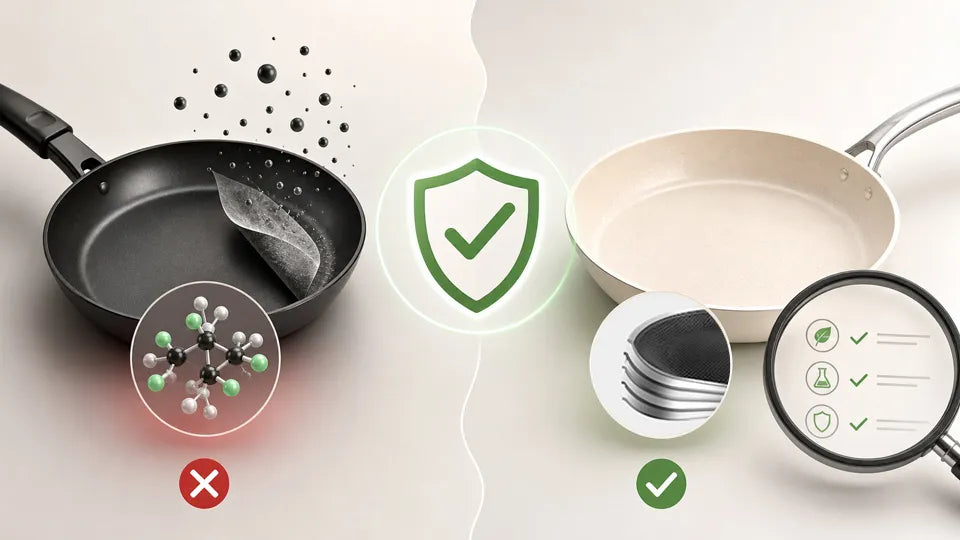
PFAS-free cookware means the pan is manufactured without per- and polyfluoroalkyl substances, a broad family of synthetic compounds commonly referred to as "forever chemicals." In cookware, this typically indicates that the cooking surface does not use PTFE, the fluoropolymer coating found on traditional black nonstick pans.
If you are navigating product labels such as PFOA-free, PTFE-free, PFAS-free, and Teflon-free, the distinctions can quickly become confusing. This guide breaks down what each label means, which certifications truly protect your health, and how to choose safe, high-performance cookware without falling for misleading greenwashing claims.
Quick Comparison: PFAS vs. PTFE vs. Teflon vs. PFOA
Here is the clearest way to understand these related terms:
| Terminology | Scientific Definition | Role in Cookware Manufacturing |
|---|---|---|
| PFAS | A broad family of thousands of synthetic fluorochemicals | The overarching chemical category |
| PTFE | Polytetrafluoroethylene, a specific polymer within PFAS | The primary chemical coating in classic nonstick cookware |
| Teflon | A registered trademark brand name owned by Chemours | A commercial brand name, not a distinct chemical class |
| PFOA | Perfluorooctanoic acid, an older processing aid in the PFAS family | Largely phased out globally in modern cookware manufacturing |
The Key Takeaway
PFAS represents the parent chemical family. PTFE and PFOA are specific compounds beneath that umbrella, while Teflon is simply a brand name. To ensure your kitchen is completely free of fluorochemicals, look specifically for verified PFAS-free cookware rather than just a narrow PFOA-free claim.

What Are PFAS in Cookware?
PFAS stands for per- and polyfluoroalkyl substances. These engineered chemicals are known for their exceptional resistance to water, grease, staining, and thermal breakdown.
Because of these barrier properties, PFAS compounds are widely utilized across consumer industries, including:
- Traditional fluoropolymer nonstick pans
- Grease-resistant fast-food packaging
- Waterproof outdoor textiles and apparel
- Stain-resistant upholstery and carpeting
- Certain waterproof cosmetics
- Specialized industrial coatings
PFAS are known as "forever chemicals" because their strong carbon-fluorine bonds prevent them from degrading naturally in the environment. For detailed scientific research and environmental guidance, consult the US EPA's official overview on PFAS regulations and research.
What Does PFOA-Free Mean?
PFOA-free cookware signifies that a vessel was manufactured without perfluorooctanoic acid, a legacy chemical formerly used as an emulsifier in the production of nonstick coatings.
While seeing "PFOA-free" is reassuring, it does not guarantee that the cookware is entirely non-toxic or free of fluoropolymers.
A pan labeled PFOA-free can still be:
- Manufactured with traditional PTFE coatings
- Processed with alternative fluorinated surfactants (such as GenX)
- Subject to the same thermal breakdown concerns as standard nonstick coatings
Consequently, a PFOA-free label represents a narrow regulatory claim rather than a guarantee of a chemical-free pan. Most contemporary nonstick pans sold today are PFOA-free by law, yet many still rely on PTFE fluoropolymer surfaces.

What Does PTFE-Free Mean?
PTFE-free cookware confirms that the cooking surface contains no polytetrafluoroethylene. This is the exact slippery coating responsible for traditional nonstick pan performance.
Understanding these critical labeling distinctions helps avoid confusion:
- PTFE-Free: Contains zero PTFE fluoropolymer coatings on the cooking surface.
- PFAS-Free: Formulated completely without any chemical compounds from the PFAS family.
- PFOA-Free: Excludes only PFOA, but may still contain PTFE or other fluorinated substances.
If you are specifically trying to avoid traditional nonstick chemistry, look for cookware labeled:
- PFAS-free cookware
- PTFE-free cookware
- PFOA-free cookware
- Non-toxic cookware
- Best nonstick pan without Teflon
Always check the product details and material specifications rather than relying solely on front-of-box claims.

Is Teflon the Same as PFAS?
No. Teflon is a proprietary brand name, PTFE is the specific chemical polymer, and PFAS is the umbrella chemical family.
The hierarchy breaks down as follows:
PFAS (Broad Family) → PTFE (Specific Compound) → Teflon (Commercial Brand)
Not all PFAS chemicals are PTFE, and many PTFE-coated pans are sold under generic names rather than the Teflon trademark. Therefore, a product labeled "Teflon-free" may still contain standard PTFE nonstick coatings unless explicitly verified as PTFE-free or PFAS-free.

Is PFAS-Free Cookware Safer?
Choosing PFAS-free cookware is a dependable way to eliminate fluorinated chemical exposure and accidental off-gassing from overheated pans in your home.
However, overall cookware safety involves several practical design and usage factors:
- The cooking surface composition
- Maximum safe oven and stovetop temperature limits
- Whether the pan scratches easily
- Whether the coating can chip or peel
- How do you clean and maintain it
- Whether it is oven-safe cookware
- Whether it works efficiently with your stovetop
For example, stainless steel cookware does not rely on a nonstick coating, but it has a slight learning curve. Ceramic nonstick cookware is often PFAS-free, but it may lose its slickness over time if overheated or cleaned incorrectly.
The safest cookware material for your kitchen ultimately depends on your daily cooking habits.
Best PFAS-Free Cookware Materials
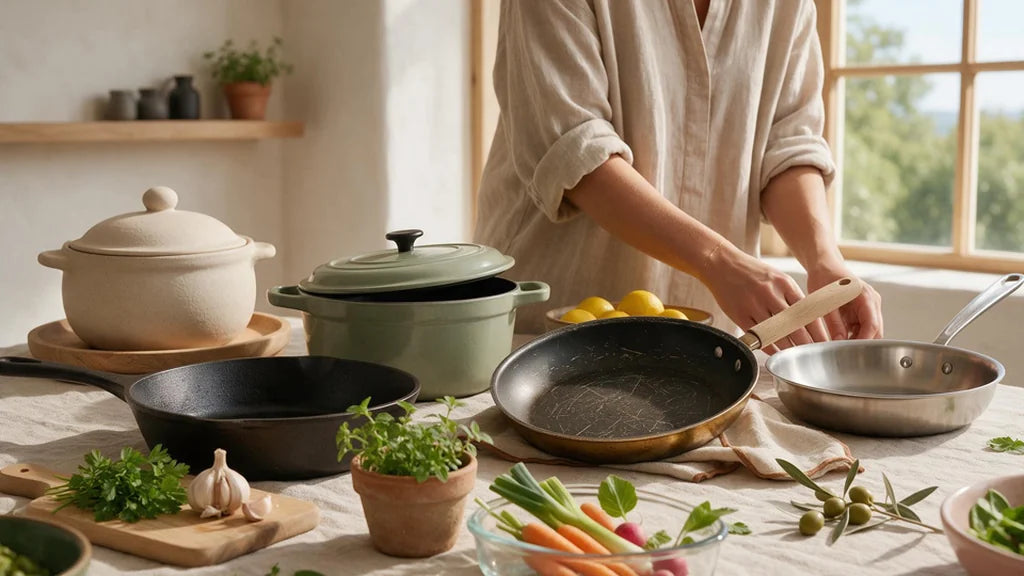
If you want to transition to a chemical-free kitchen, these are the most common and reliable options:
1. Ceramic Nonstick Cookware
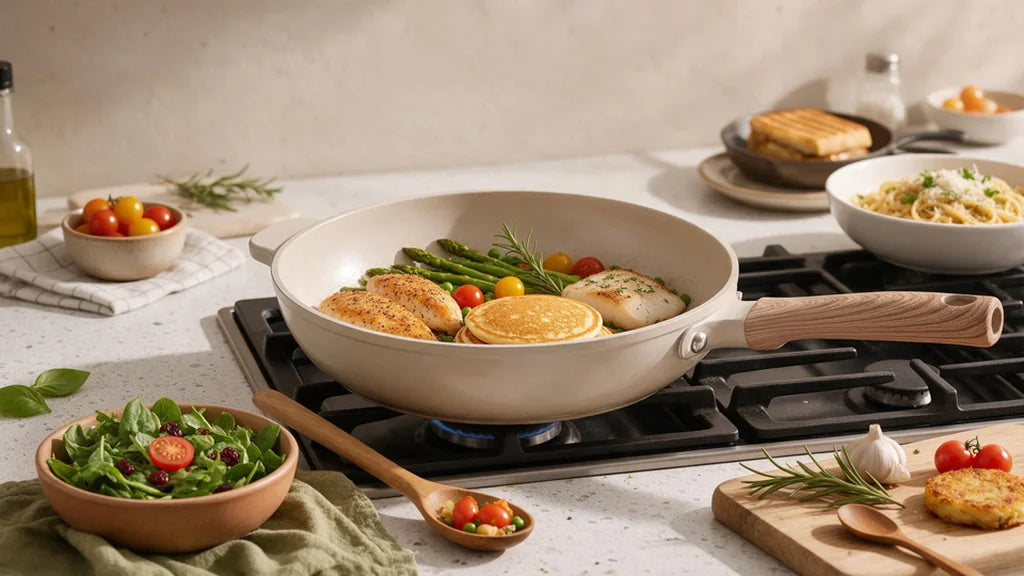
Ceramic nonstick cookware usually utilizes a silica-based coating instead of PTFE. It is easy to use and works well for eggs, omelettes, pancakes, and low-to-medium heat cooking.
The trade-off is that ceramic-coated cookware can lose release performance over time, especially if subjected to high heat, cooking sprays, or abrasive scrubbers. If you are comparing ceramic options, see our guide to ceramic cookware pros and cons.
2. Clad Stainless Steel Cookware
Stainless steel cookware is naturally PFAS-free because it does not require a nonstick coating. The trade-off is technique: stainless steel pans can stick if they are too cold, too hot, or used without sufficient cooking fat.
3. Carbon Steel and Cast Iron
Carbon steel and cast iron are also PFAS-free options. They do not use synthetic nonstick coatings; instead, they develop a natural, slick cooking surface through seasoning. The downside is maintenance, as they require drying, oiling, and seasoning care to prevent rust.
4. Hybrid Ceramic Cookware
Hybrid cookware can be PFAS-free, but not always. Some hybrid cookware pairs stainless steel with a PTFE-based layer, while others use mineral-based ceramic coatings. If the label only says "PFOA-free," that does not automatically mean it is PFAS-free. You can explore our dedicated PFAS-free cookware collection for options made without traditional fluorinated coatings.
Is PFOA-Free Cookware Enough?
For many health-conscious shoppers, PFOA-free is not specific enough. It confirms that the pan does not contain one particular phased-out chemical, but it does not tell you whether the pan uses PTFE or another fluoropolymer coating.
If your goal is to avoid the broader PFAS family, look for stronger claims:
- PFAS-free cookware
- PTFE-free cookware
- Teflon-free cookware
- Non-toxic nonstick cookware
- Best non-toxic pans
A simple rule to remember: PFOA-free is good to know, but PFAS-free is the broader and more protective claim.

How to Read Cookware Labels Without Getting Misled
Cookware marketing can be vague. Use this checklist before making a purchase:
1. Look for the Exact Coating Type
Do not stop at vague terms like "non-toxic" or "eco-friendly." Look for clear details: Is it PTFE? Is it ceramic-coated? Is it stainless steel, carbon steel, or cast iron? Does it have an independent test report?
2. Check If It Explicitly Says PFAS-Free
If the product only mentions "PFOA-free," keep reading the fine print, as that claim may still allow PTFE coatings.
3. Check the Heat Limits
Even safe cookware can be damaged by excessive overheating. For coated pans, avoid high heat unless the manufacturer explicitly approves it.
4. Avoid Metal Utensils on Coated Pans
Even if a pan claims to be scratch-resistant, smooth silicone, wood, or heat-resistant nylon utensils are much safer for prolonging the coating lifespan.
5. Avoid Aerosol Cooking Sprays
Aerosol cooking sprays leave an invisible, sticky residue that polymerizes and degrades ceramic nonstick surfaces over time. Use a small amount of oil or butter instead.

PFAS-Free vs. Ceramic Cookware: Are They the Same?
Not always, but they often overlap. Many ceramic nonstick pans are PFAS-free because they use a silica-derived mineral coating instead of PTFE. However, cookware labeled "ceramic" generally falls into two distinct categories:
1. Ceramic-Coated Cookware
This consists of a metal core (such as aluminum or stainless steel) coated with a ceramic nonstick finish. It is lightweight, heats quickly, and is common in everyday cookware sets.
2. 100% Pure Ceramic Cookware
This is crafted entirely from kiln-fired clay and natural minerals rather than coated metal. It is heavier, heats more slowly, and requires careful handling to avoid chipping.
Whether ceramic cookware is safe depends on the quality of the mineral formulation, third-party testing, and adherence to proper cooking temperatures.
Should You Replace Your Current Nonstick Pans?
You do not necessarily need to replace every nonstick pan immediately, but replacement is highly recommended if:
- The coating is actively peeling, flaking, or chipped
- The cooking surface has deep scratches exposing the bare base metal
- Food constantly sticks despite proper cleaning and light oiling
- The pan was severely overheated while empty
- The base is visibly warped and rocks on flat cooktops
- You want to transition your kitchen entirely to PFAS-free materials
For cooks who prepare eggs and delicate breakfast foods daily, switching to a dedicated PFAS-free ceramic frying pan offers a healthy, high-release alternative to legacy nonstick pans.
What Is the Best PFAS-Free Cookware Material?
There is no single best cookware material for every kitchen task. Here is a practical breakdown based on cooking needs:
| Cooking Task | Recommended PFAS-Free Choice |
|---|---|
| Eggs and delicate omelettes | Ceramic nonstick cookware |
| Steaks, browning, and searing | Stainless steel, cast iron, or carbon steel |
| Pasta, soups, and boiling | Stainless steel pots |
| Everyday frying and sautéing | Ceramic hybrid, carbon steel, or stainless steel |
| Induction cooking versatility | Stainless steel induction cookware, induction-compatible cookware |
| Low-maintenance cooking | Ceramic-coated cookware |
| Lifetime durability | Multi-clad stainless steel cookware |
If you want the safest cookware with zero coating concerns, stainless steel, carbon steel, and cast iron are unmatched. If effortless release with minimal oil is your priority, ceramic nonstick is the most practical solution.
Final Thoughts on PFAS-Free Cookware
PFAS-free cookware ensures your cookware is crafted without persistent synthetic "forever chemicals." For shoppers comparing options, looking for verified PFAS-free and PTFE-free labels provides much stronger protection than relying on basic PFOA-free marketing.
Whether you choose durable clad stainless steel, seasoned carbon steel, or high-performance ceramic nonstick pans, selecting the right material for your cooking style guarantees safer meals and reliable results.
FAQs About PFAS-Free Cookware Labels
Is Teflon-free cookware always PFAS-free?
Not necessarily. Teflon is a brand name. A pan may be marketed as Teflon-free but still use another PTFE-based coating unless the manufacturer clearly verifies that it is PFAS-free or PTFE-free.
Are ceramic nonstick pans safe?
Ceramic nonstick pans are widely recognized as safe, PFAS-free alternatives. They are non-toxic when used as directed, provided you avoid overheating, abrasive scourers, and aerosol cooking sprays.
Can PFAS-free cookware be nonstick?
Yes. Ceramic nonstick cookware is the most common PFAS-free nonstick option. While it may require gentler care than PTFE coatings, it provides slick food release without fluorinated chemicals.
What should I avoid in nonstick cookware?
Avoid excessive high heat, metal utensils, abrasive scrubbers, and continuing to use pans with peeling or flaking coatings. In addition, avoid vague labels that only claim "PFOA-free" if your goal is completely fluorochemical-free cookware.
Is PFAS-free cookware worth it?
Yes, particularly if you want to eliminate synthetic fluorochemicals from your kitchen and prefer non-toxic cooking surfaces. Choose the right material according to your cooking style: ceramic for effortless low-fat release, stainless steel for lifetime durability, and cast iron or carbon steel for superior high-heat searing.