Thanksgiving Cookware Checklist: What You Actually Need (and What You Can Skip)
Most Thanksgiving cookware checklists run twenty items deep. You don't need twenty items. You need the four or five pieces that actually touch your menu, and the discipline to skip the rest. This guide builds the list from your dishes backward, not from a store shelf forward.
Start With Your Menu, Not Your Cabinet
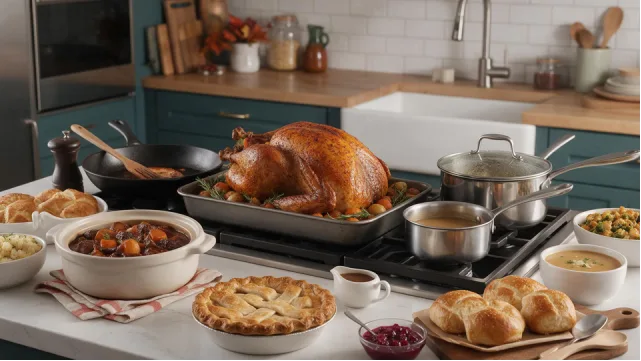
The cookware you need depends on your menu, not on a generic checklist. A basic meal with a main dish, two sides, gravy, and bread needs four to five pieces, not the twenty-plus items most lists recommend.
Write down the dishes you're actually making first. Four to six items is typical for a first-time host. Then match each dish to what it needs:
lMain dish (turkey, ham, chicken, roast): roasting pan, Dutch oven, or sheet pan.
lMashed potatoes: large Dutch oven or stockpot.
lGravy: 3-quart saucepan.
lCranberry sauce: 2-quart saucepan.
lBaked side (green bean casserole, sweet potato): sauté pan or baking dish.
lDinner rolls: griddle pan or sheet pan.
lPie: pie dish or glass baking dish.
Once you have that list, check your cabinet. Most kitchens already have a stockpot, a frying pan, and a baking sheet. The gap is usually the large piece, a roasting pan or a Dutch oven, and possibly a second saucepan. For a basic meal, that works out to four to five pieces: one large roasting piece, one large pot, one sauté pan, one saucepan, and one large pan.
The Main Dish: Turkey, Ham, Chicken, or Something Else
A whole turkey needs a roomy, oven-safe vessel that can hold the bird and its drippings without crowding. A dedicated roasting pan is convenient, but a sturdy rimmed sheet pan with an oven-safe rack may also work when its dimensions and weight capacity are appropriate. Ham, whole chicken, turkey breast, and roast beef can all be handled in a large Dutch oven. Smaller households often skip the turkey altogether.

Whole turkey
A whole turkey needs a roasting pan with enough surface area for the bird to sit flat and raised sides to catch drippings. Size guide:
l8 to 12 lb: 14 to 16 inch pan.
l12 to 16 lb: 16 inch pan.
l16 to 20 lb: 18 inch pan.
lOver 20 lb: check whether your oven can fit the pan before buying.
Depth matters as much as width. The sides need to hold a cup or two of drippings without spilling.
A whole turkey will not fit in a standard Dutch oven. It's too long and too tall, and the high walls would steam the skin instead of roasting it.
Ham
A bone-in half ham in the 7 to 10 lb range fits in an 8-quart Dutch oven. A whole ham needs a roasting pan instead, because the shank extends too far.
Whole chicken
An 8-quart Dutch oven handles a 4 to 5 lb chicken without trouble. For households of two to four, it's often a better choice than a turkey: smaller, faster, easier to cook evenly. Roast uncovered, or with foil laid loosely on top. If you use the lid, check your cookware's guide first.
Turkey breast
An 8-quart Dutch oven fits a 3 to 4 lb bone-in turkey breast. It serves three to six people and cooks in a fraction of the time a whole bird requires. Boneless works too, but dries out faster, so pull it early.
Roast beef
A 3 to 4 lb roast fits in a 5.4-quart or 8-quart Dutch oven. Sear it on the stovetop first, then move the pot into the oven.
Vegetarian main dishes
A whole roasted pumpkin or squash fits on a sheet pan or in a Dutch oven. Mushroom wellington goes on a sheet pan. Neither needs a roasting pan or a rack, which is worth noting if your main dish is the reason you were considering a new pan in the first place. A vegetarian menu often simplifies the cookware list rather than adding to it.
Sides: The Real Star of the Table
Sides take more cookware than the main dish. Most kitchens need one large pot for mashed potatoes, one sauté pan for a baked side, and one sheet pan for bread or vegetables. These can all be prepped a day ahead.

Mashed potatoes
An 8-quart Dutch oven or a large stockpot cooks enough for six to eight people in one batch, and you can mash right in the same pot. If making them a day ahead, undercook slightly and finish with butter and cream on Thursday.
Stuffing and baked sides
A 3.7-quart or 5-quart sauté pan handles the vegetable-and-bread base on the stovetop. A wider pan is easier because you can spread the bread cubes in a single layer to toast them before adding stock. A 5-quart sauté pan can also take a green bean casserole or sweet potato casserole from stovetop to oven without a transfer.
Dinner rolls and bread
A 13-inch griddle pan or a sheet pan both work. The griddle pan bakes eight to ten rolls at once and gives good bottom browning. A sheet pan holds more. Use whichever you already have.
What can be made ahead
lCranberry sauce: up to three days ahead.
lMashed potatoes, casseroles, and cut vegetables: one day ahead.
lPie: the day before, or the morning of.
lDinner rolls: bake fresh, or buy them ready-made.
Prepping ahead reduces the number of simultaneous tasks on Thursday, which is when kitchen problems actually happen.
Gravy, Sauces, and the Saucepans You Need
You need two saucepans, not four. A 3-quart saucepan handles gravy and giblet stock. A 2-quart saucepan handles cranberry sauce. A 1.3-quart pan is useful for small batches but not essential.

Gravy
Gravy starts with the drippings from the roasting pan and thickens on the stovetop. A 3-quart saucepan gives you enough room to whisk without splashing. Giblet stock can simmer in the same pan earlier in the day, then get strained and set aside. One pan, two jobs.
Cranberry sauce
A 2-quart saucepan is right for a standard bag of cranberries. The berries need room to pop and bubble. This is one of the easiest dishes to make three days ahead, and it improves after a day or two as the flavors settle.
What you don't need
A turkey baster is on almost every checklist. Skip it. A large spoon or pastry brush does the same job. A gravy separator is also optional. Let the drippings sit for a few minutes, and the fat rises to the top for easy spooning off.
Oven Space Planning
Most home ovens fit two dishes at once. Plan which dish goes in first, which waits, and which can be finished on the stovetop. Turkey takes the longest and should go in first.
The one-oven reality
A typical home oven may have two or more rack positions, but usable space and heat distribution vary by model. If the turkey occupies the center of the oven, the remaining rack space may be limited. Everything else has to be planned around that. That's why an experienced host starts with a written schedule rather than improvising.
Order of operations
lTurkey: high heat to start, then moderate. Longest time. Goes in first.
lBaked side: moderate. 30 to 45 minutes. After turkey comes out and rests.
lSweet potato casserole: moderate. 30 to 40 minutes. Same window.
lRolls: moderate. 10 to 15 minutes. Last 15 minutes.
lPie: moderate. 45 to 60 minutes. During turkey rest, or the day before.
The pattern is consistent: the largest piece of meat gets the oven first, and everything else is scheduled around it.
What can be finished on the stovetop
Mashed potatoes, gravy, green beans, and cranberry sauce can all be finished or held on the stovetop. While the turkey rests, you can reheat potatoes, finish gravy, and warm rolls without adding anything to the oven. Just confirm each dish fits alongside whatever goes in with it.
Writing the schedule on paper on Wednesday and taping it to the fridge prevents most of the last-minute problems on Thursday.
What If You Don't Have a Roasting Pan?
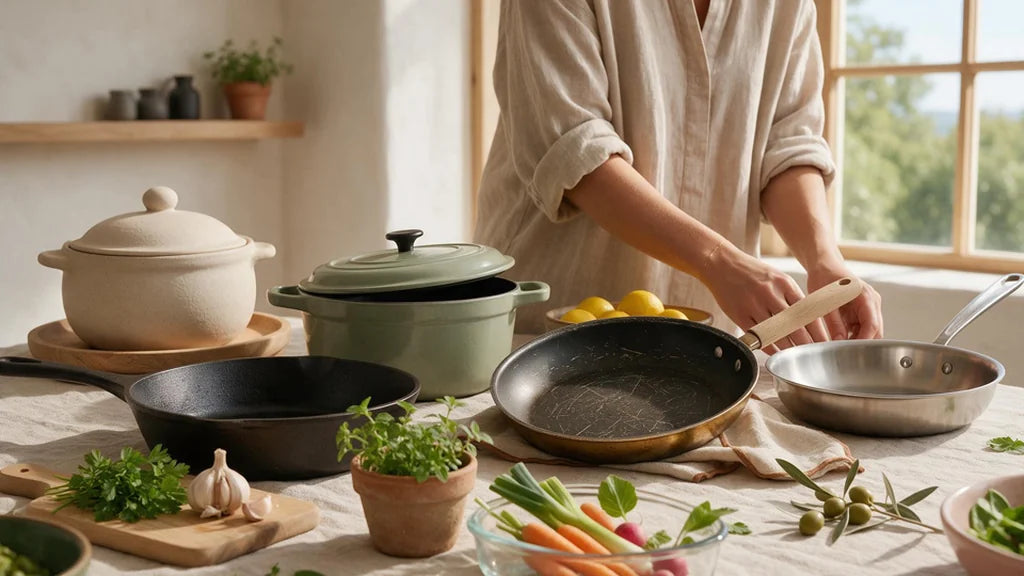
You can roast a turkey without a dedicated roasting pan. A rimmed sheet pan with a wire rack is the most common substitute. A cast iron skillet works for birds up to about 12 lb. A Dutch oven works for turkey breast and whole chicken, but not a whole turkey.

Sheet pan with a wire rack
A sturdy rimmed sheet pan with an oven-safe rack can work for a turkey that fits securely within the pan’s dimensions and weight capacity. The pan needs a raised rim, since a flat cookie sheet won't hold drippings. A thin pan may warp at high heat.
Cast iron skillet
A 12-inch skillet handles a turkey up to roughly 12 lb. Treat the skillet and its handle as hot throughout cooking. Use dry, heat-resistant oven mitts when moving the pan. And set the pan on a sturdy surface before lifting it out of the oven. For larger birds, cast iron gets too heavy and too narrow.
Dutch oven
If you have one, it covers everything except a whole turkey: turkey breast, whole chicken, ham, and roast beef. Use it uncovered, or with foil laid loosely over the top. Avoid sealing the lid unless you've confirmed its temperature rating.
Glass or ceramic baking dish
Works for turkey breast and whole chicken, not a whole turkey. Bring the dish to room temperature before it goes into a hot oven, and don't move it straight from the oven to a cold countertop.
What to use instead of a roasting rack
A wire cooling rack set inside a sheet pan is the most common workaround. You can also shape foil into a thick ring and rest the bird on it, or lay rings of onion and carrot underneath as a bed. All three keep the bird out of the drippings and let air circulate so the skin browns.
What You Can Skip
Several tools on published lists aren't necessary for a home cook. If you're hosting once a year, skip anything with a single purpose.
Turkey fryer. Skip unless you're deep-frying a turkey. It takes up storage space and gets used once a year at most.
Electric carving knife. Skip if you have a sharp chef's knife and a carving fork.
Mandoline. Skip unless you're making thin-sliced dishes that require uniform thickness.
Dedicated pie dish. Skip if you already own a glass baking dish of a similar size.
A second roasting pan. Skip if your oven only fits one at a time.
Disposable aluminum pans. Thinner, flex under load, and don't hold heat the same way as reusable pans. Useful if you're short on pans for one specific task, but not a replacement for a roasting pan.

A Quick Budget Breakdown
You can host Thanksgiving with a minimal setup, or you can add pieces that work year-round. The difference is not whether the meal succeeds. It's how much of the cookware you'll use again in January.
The minimum setup
lOne 8-inch or 10-inch frying pan.
lOne 3-quart saucepan.
lOne pan, which most kitchens already have.
Two pieces to buy, if you already own a sheet pan. This covers a small meal for two to four people: a turkey breast or roast chicken, one side, and gravy.
Adding flexibility
lOne 8-quart Dutch oven for the main dish and mashed potatoes.
lOne 5-quart sauté pan for baked sides.
lOne 3-quart saucepan for gravy and one 2-quart saucepan for cranberry sauce.
Handles a full Thanksgiving meal for six to eight people without needing a roasting pan. It also covers most weeknight cooking the rest of the year.
Building a full kitchen
A 13-piece cookware set if you're furnishing a kitchen from scratch.
The value of a set is that you get the pieces you'll actually use, in sizes that match the way you cook. It's worth checking that a set covers the specific dishes you make. A set with three frying pans isn't useful if you mostly braise and simmer.
Thanksgiving Cookware Checklist: Conclusion
The best Thanksgiving cookware list is the one that matches the meal you're actually cooking. If you're hosting for the first time, start with the core pieces, add as your menu grows, and let your own kitchen decide what earns its place.
Frequently Asked Questions About Thanksgiving Cookware Checklist
How many pounds of turkey do I need per person?
Plan for 1 to 1.5 pounds per person if you want leftovers, and about 0.75 to 1 pound per person if you are cooking exactly enough. For 10 guests with leftovers, that means a 12 to 15 pound bird. The 1.5 pound figure accounts for bone weight, which runs about 25% of the total.
Can you cook a turkey in a slow cooker?
Yes, but only a turkey breast or a very small bird, since a standard slow cooker holds about 6 quarts. A whole 12 pound turkey will not fit. Breast meat cooked this way stays moist because the environment is sealed and steaming, but the skin will not crisp and should be discarded or finished under a broiler.
How long should a turkey rest before carving?
Rest it 20 to 30 minutes, tented loosely with foil. The internal temperature may continue to rise during the rest, but the amount varies. If you carve immediately, the juices run out and the meat dries on the plate. The rest is one of the few steps most people skip and later regret.
Do you really need a meat thermometer for turkey?
Yes. Turkey is one of the few dishes where timing alone isn't reliable. For a whole turkey, confirm that the thickest part of the breast, the innermost part of the thigh, and the innermost part of the wing have each reached at least 165°F. Keep the thermometer tip away from bone. Use the current safe-temperature guidance for the specific type and cut of meat. Poultry, ground meat, and whole cuts of beef, pork, or lamb do not all share the same requirements.